

This is a case study on how I built a website that receives over 100,000 visitors per month, in less than 1 year, without spending $1 on advertising.
This was done 100% through SEO and content strategy.
Before we dive in, allow me to clarify a few things:
- The website reached over 100,000 visitors in 9 months.
- This was a new domain, registered just a couple months before launch.
- This was done in a language I do not read nor speak (Japanese).
- Japanese is a non-roman character language, making it nearly impossible to use most of the popular SEO tools.
Key Drivers of Traffic Growth
There were a few key elements that led to the widespread and sustained growth of the project, these range from commonsense to technical, but come down to three main focus areas:
- Math - we took a mathematical approach to designing an evaluation model that would allow us to gauge opportunities based on their potential returns. Ultimately this led to the creation of what we now call our keyword opportunity evaluation, which is a financial model that measures the approximate output (traffic) based on a finite set of inputs, including elements like average DA, number of links / linking domains, age of site, content footprint, etc.
- Analysis – Using our newly built algorithm we got to testing, creating websites to test content patterns and architecture. We were quick to declare defeat within verticals without traction, and paid close attention to where the traffic was growing the most. The algorithm started to take shape and after roughly 3 months was able to identify within an order of magnitude the amount of traffic we could acquire for a given set of costs.
- Pumpkin Hacking – This is a term that I came across (thank you Peter Da Vanzo) that seems to describe exactly what we did to continue to grow our traffic by double and even triple digits, month after month. The core concept is simple; focus resources on building what works. What this meant for us was paying attention to the search verticals and content that received the most traffic, most comments, most social shares, and being quick to cut the cord on traffic that didn’t perform.
First Month After Launch
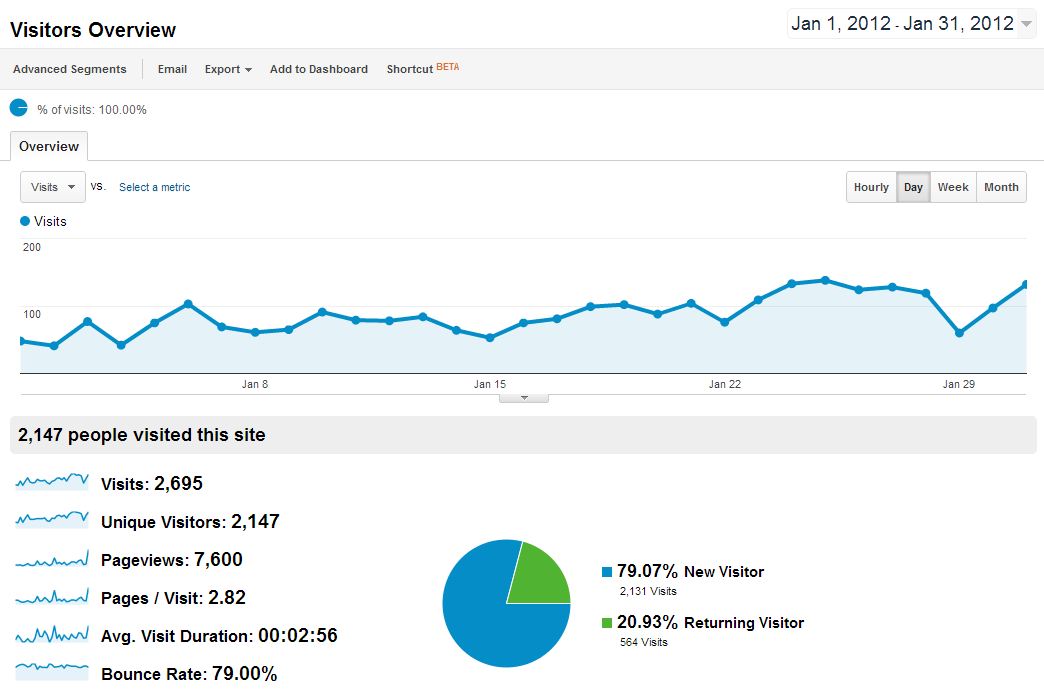
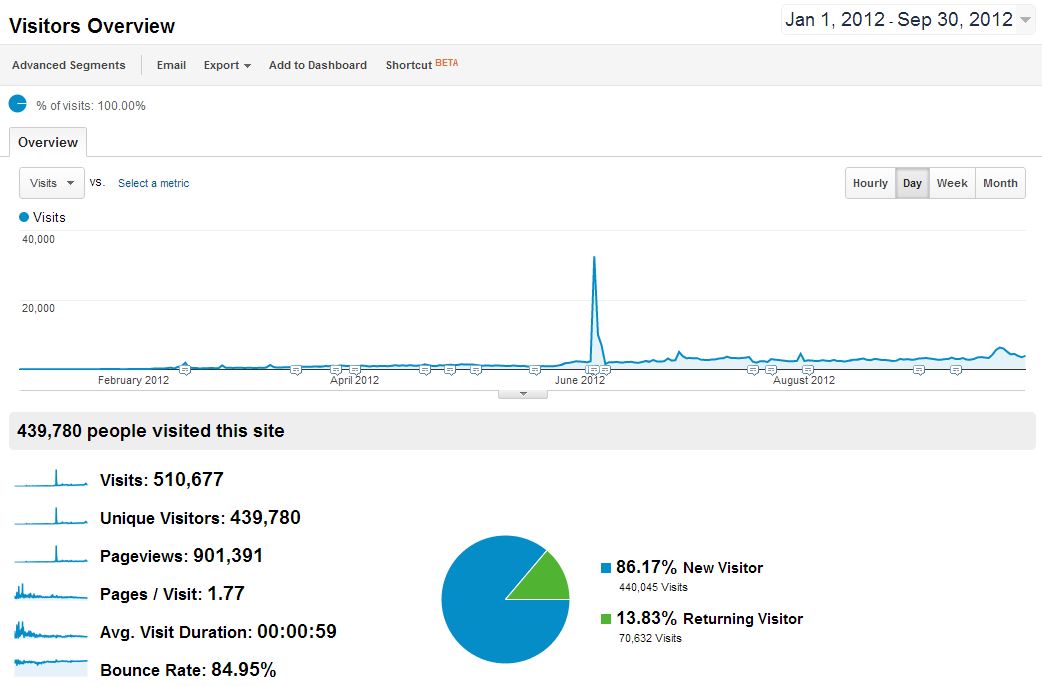
With zero promotion and no advertising, we had a decent first month, bringing in over 2,000 visitors. This was mostly due to our pre-launch strategy – which I’ll explain more later in this post.
Nine Months After Launch
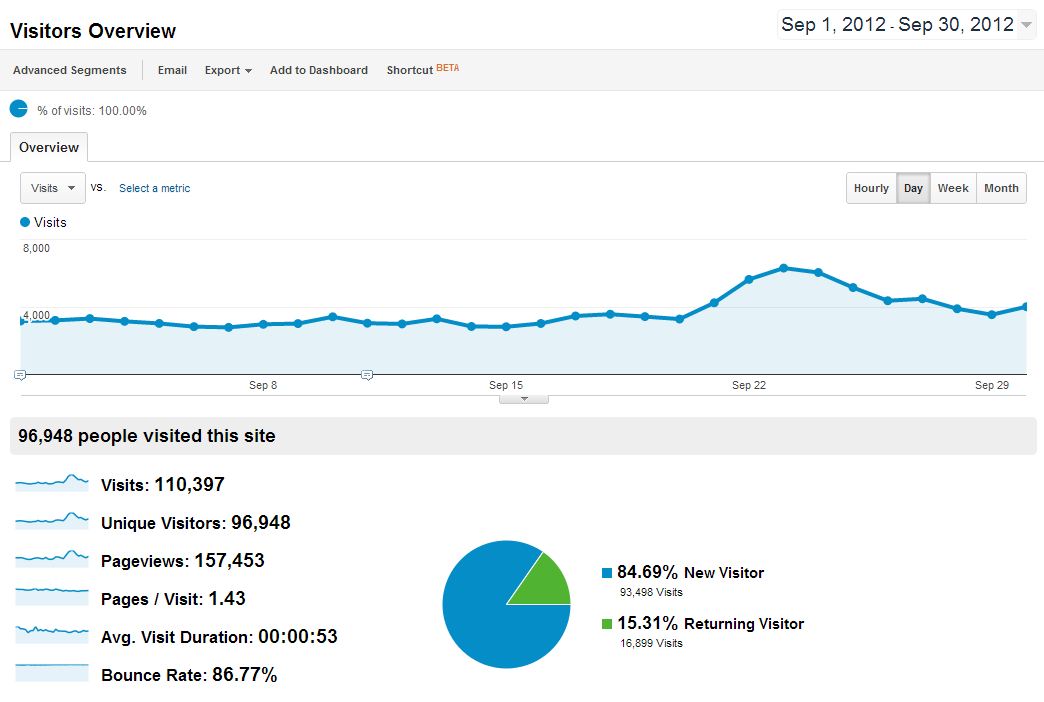
After only 9 months we were 3 months ahead of schedule to pass 100,000 visitors with no signs of slowing down.
Traffic Sources
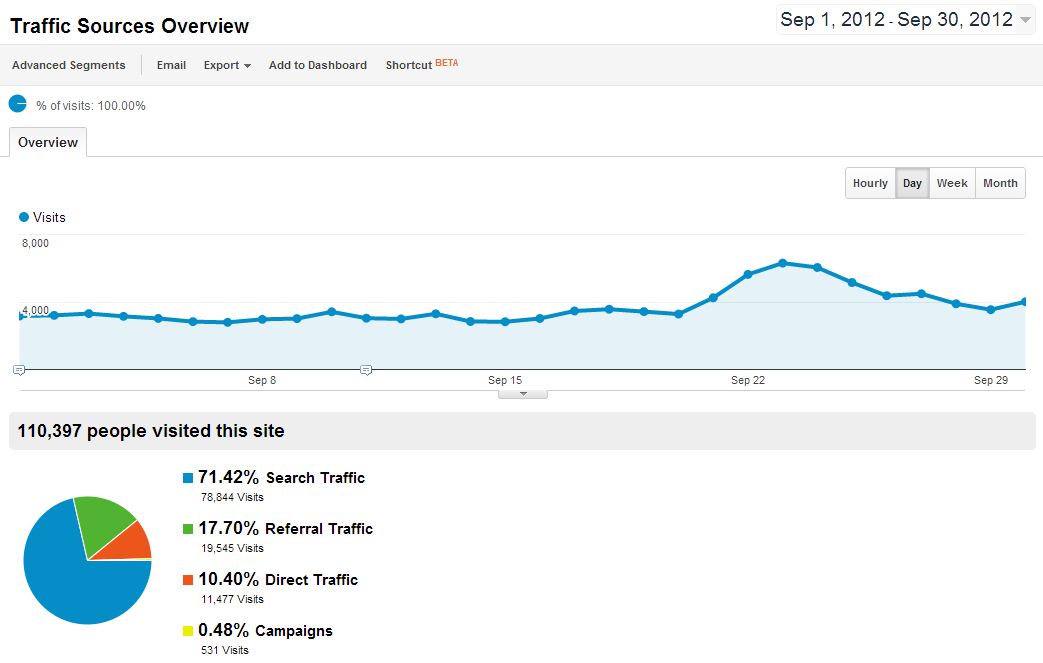
As you can see in the screenshot above, organic search drives the most significant portion of our traffic. Referral traffic is almost entirely from blogs and industry publications, and campaigns is representative of the ads that we place, only on our website, to test different language and call to actions to drive conversions.
Building a Keyword Database
This is an obvious no-brainer for all SEO’s, however, unlike most search campaigns – this was a big keyword database, to the tune of 50,000 keywords.
The main idea here was leave no stone un-turned. Since we were of the mind to test everything and let the performance metrics dictate where to allocate resources, we had to get creative with query combinations.
We first went through all of our target search verticals, as dictated by our chosen go-to-market categories, which I think was roughly 19 to start. The next step was to identify the top 100 highest search volume terms within those verticals and scrape the top 100 URL’s that were currently ranking.
From here we began what started out as an exhaustive process of evaluating the opportunities for each keyword, and then aggregating opportunities to discern which categories we needed to focus on to grow traffic.
Essentially we targeted the low-hanging fruit; keywords identified by our model that could generate a minimum level of traffic in 3 months or less, with a minimum investment in content development.
I watched (obsessively) which phrases and topics generated the most traffic.
As soon as a topic began to grow legs, we would focus additional keyword research on finding concepts and phrases that were both complimentary and contextually relevant.
Designing a Content Strategy
This is the single hardest part of any content-focused website or project.
The key to success on this particular project was taking a page out of Jeff Bezos’ book, and becoming obsessed with our customers.
We not only embarked on an aggressive a/b testing schedule, but we constantly reached out to our users for feedback.
We asked tough questions, ranging from what users’ liked and disliked (colors, fonts, and layouts) but also the specific components of the website they found to be less than ideal or even ‘sub-par.’
We took the responses seriously, making changes as they came in, trying to take something constructive from every piece of feedback, and pushing as many as 10 deployments a week.
It started to work.
Once we saw the needle begin to move on our user engagement metrics; time on site, pages per visit, and direct or branded traffic, we moved onto the next phase of our strategy; analyzing our audience.
Targeting the right audience is so much harder than it sounds.
I can honestly say from the experience of working on this project it is almost never as it seems. We began with targeting a very large segment of users (remember that time I talked about a keyword database of over 50,000 keywords?) but after a few months it turned out our largest (and most active) users were finding us from only a handful of targeted categories.
Information Architecture with SEO in Mind
Please allow me to preface this by saying that I am bias; in my opinion the architecture of a website is critical to achieving SEO success.
My largest successful SEO projects have come due to a variety of factors, but tend to come down to 3 core components of architecture:
- It’s Scalable
- It’s Crawlable
- It’s Tiered
Scalable architecture is an obvious one; you need a system that can grow as large as you want/need it to.
Crawlable is nothing new to anyone in SEO; this simply means that the structure of our pages allowed for all of the most important content to quickly and easily be crawled and indexed by search engine robots. It actually sounds easier than it is… ensuring that the content is rendered (code wise) in the most ideal format for robots to parse takes more consideration than just laying out your div’s to properly render your designs.
To do this properly you need to make sure all of your code is in the right place, and more so, check how each crawler sees your page.
Take every opportunity to DRY out your code as much as possible, remember modern code is designed to cascade for a reason.
Information tiering… is a concept I have long-time preached to anyone who has ever talked with me, at length, about SEO. It means that your URL architecture should be built in a way so authority flows upwards through your directories.
For example, if I wanted to build authority around a core concept, I would focus my domain on that concept. If I then wanted to build relevance around specific locations for that concept, I would structure my URL’s so that all relevant content for that location fed upwards to a location specific directory.
So let’s say I had an SEO consulting firm with locations in several cities across the U.S., I would design an architecture that would allow for location-specific information to feed upwards through my directories.
So something like NicksSEOFirm.com/Philadelphia/Specific-Location-Content. The specific location content could be the team, any value-add competencies, anything geo-specific that was relevant to operations at that location, flowing relational authority upwards to the parent directory of /Philadelphia/.
Link in sub-directories can feed authority to parent directories.
A perfect example of this is local sitelinks for popular categories; tertiary directories with the most links and content which cause their upstream sub-directories to receive authority translating into higher rankings and local sitelinks.

Launch Before The Launch
The easiest way to ensure a successful product or website launch is to launch before you actually launch.
What I mean is to build your prospect list well in advance of pulling the trigger to go live.
John Doherty wrote a great post on ProBlogger that talks about the power of leveraging list-building pre-launch pages. By building a list of users before publishing your full website you are essentially guaranteeing traffic immediately upon launch.
Our pre-launch is how we were able to generate over 2,000 visitors within the first 30 days of taking the website live.
Since our platform is not built on WordPress we didn’t get to use any of the fancy plugins available, and instead created a basic one-page site that allowed visitors to convert the same way the full website would support, just on a much smaller scale.
The most important part of our pre-launch page was that it not only supported social sharing, but was able to track and aggregate shares to give active users more points; gamification is cool.
Some of the major benefits of a well planned pre-launch are:
- Your website is already being crawled and indexed by major search engines.
- You begin building your user base and audience.
- You can gain invaluable feedback while it’s still easy to make changes.
Choosing a Platform
Let me start by saying not all platforms are created equal.
It’s also worth sharing that it is not always better to build versus buy, as there are a lot of smart people building a lot of slick content platforms.
However, we chose to build.
Once we had laid out all of the project requirements, including URL architecture, conversion funnels, user permissioning, design templating, and localization, it became clear that in order to get exactly what we needed – we were going to have to build it ourselves.
One major benefit of building is we were able to design a system that would support both our internal and external processes right out of the gate. This also meant it was going to take a lot more time and a shitload more money to bring our website to market.
Hosting & Evolution
This is a known but rarely talked about factor – hosting infrastructure is critical.
Once we were ready for public launch we setup chose a reasonably affordable VPS provider with what seemed like more than enough memory, and it was at first.
By month 4 it was clear we were going to have to make some changes; load times began to bloat and large content pages were timing out. We beefed up the space and quadrupled the memory, which solved the problem temporarily until…
We got some press.
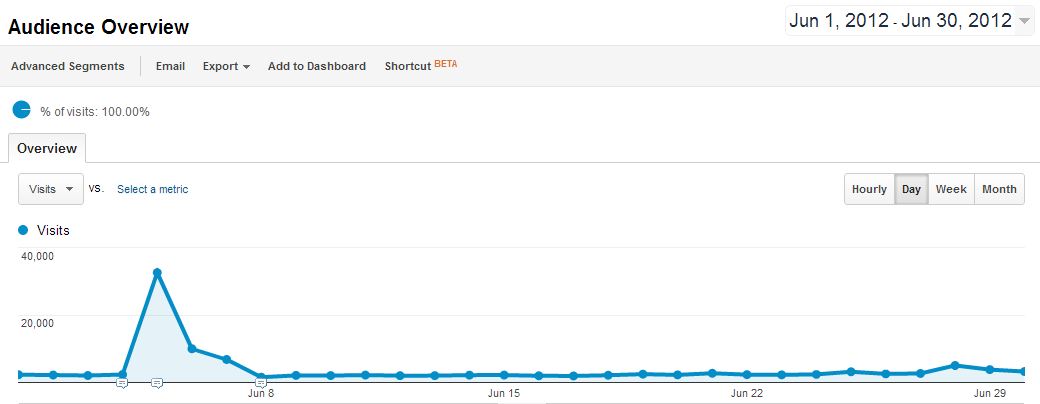
On June 5th we were featured by one of the largest news publications in the world. We were able to handle almost 40,000 visits before out VPS crashed, hard.
It was that week we made the move to localized cloud hosting from Amazon Web Services.
We haven’t crashed since.
The End Result
Not really the end result since this project is still enjoying a healthy and fruitful life, but after 9 months of careful planning, remaining flexible to the marketplace, and nurturing our most valued asset; our users, we surpassed our milestone of 100,000 visitors.
Great, But Is It Repeatable?
In case you weren’t already thinking it, you are now.
The answer is Yes.
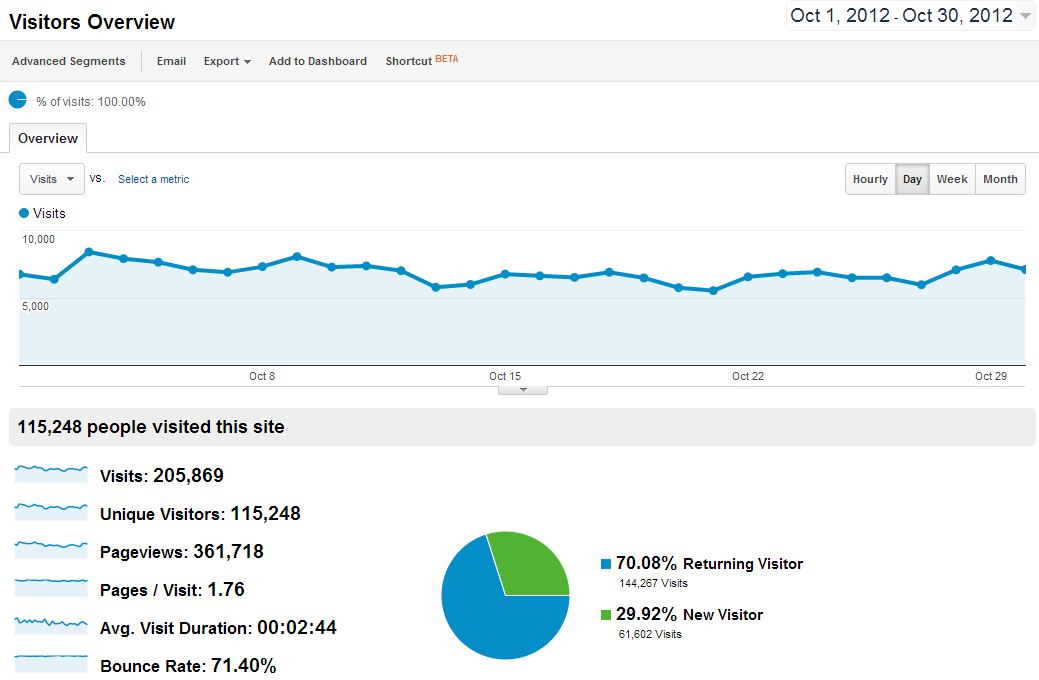
Taking what we learned and applying the concept of pumpkin hacking, we started a new blog at the end of July 2012 to test the transferability of our strategy, and here were the results:
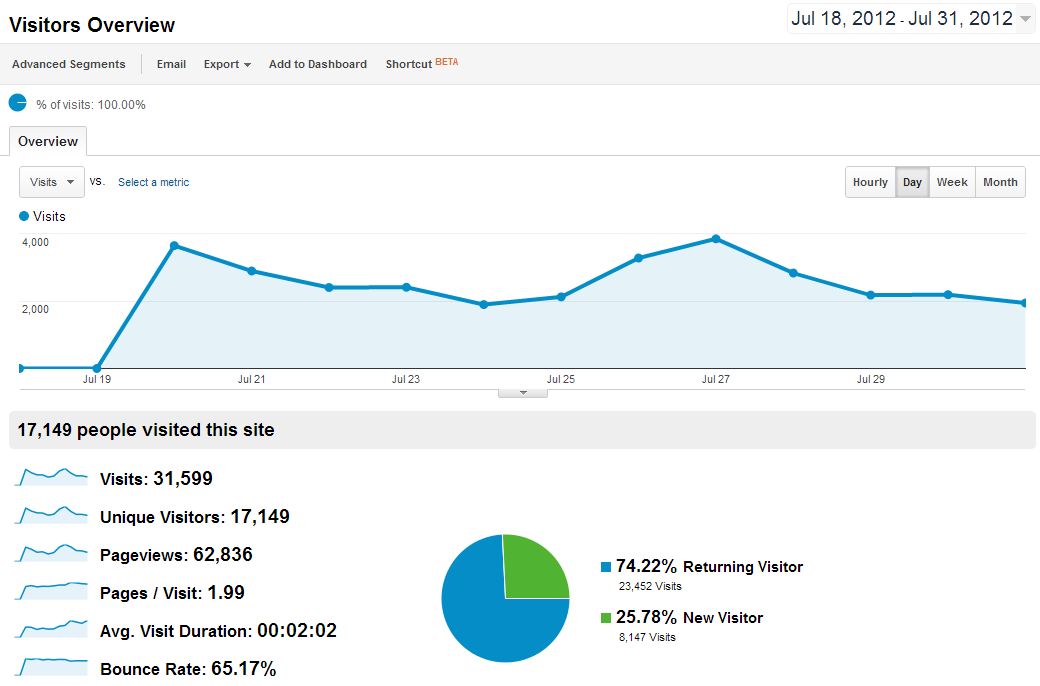
In the first 12 days we had over 17,000 visitors. In the first full month, we had over 50,000 unique visitors coming to the website over 100,000 times (see below).
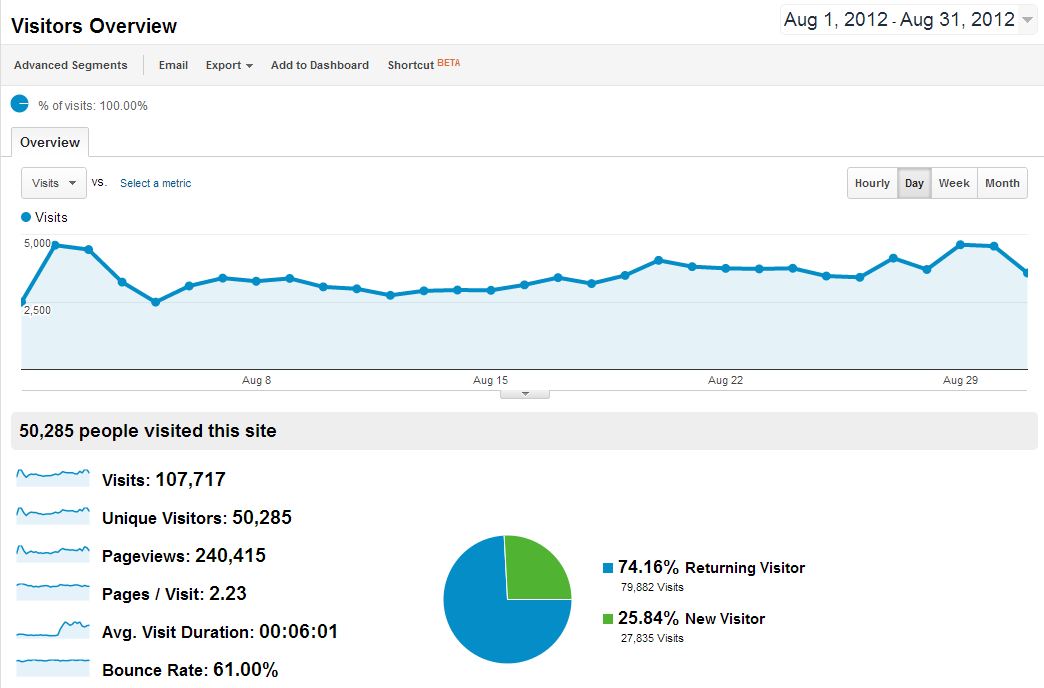
And it didn’t slow down…
By the end of the 3rd month we were receiving over 100,000 unique visitors, and over 200,000 visits.
Conclusion
This is very possible.
With careful planning, an SEO focused content strategy, and an understanding of the power of information architecture – you can grow a new website to over 100,000 organic visitors per month in less than 1 year.
Please share your thoughts, feelings, and questions in the comments below.
Thanks for reading.








{ 137 comments… read them below or add one }
Incredible Nick.. wow
I like the Pumpking hacking idea, makes sense.
I did some googling and there are 120,000 million japanese speaking people. So 100,000 unique visitors is a mean feat! Congrats!!
It is really amazing what you have achieved. I know it is possible to drive a lot of traffic using deals for example, but it is not that high in targeted traffic. I just guess a service like that (SEO only) would costs tens of thousands of dollars, right?
I guess I can’t edit my post :/ That number was supposed to be 120 million not 120,000 million lol.. The title of the post got me in the 100,000 spirit lol
Nice writeup my friend, keep it up!
Kris – Thanks so much, this was a really fun project.
Yeah pumpkin hacking is something I now use to drive strategy on all of my projects, not just websites; the core idea is really effective and forces focus.
We’re actually at 400,000+ per month between the 2 websites now and we have some pretty high goals
Amazing..
…so are you releasing a course lol
Insightful blog post Nick, glad you could share the data with everyone. Keep up the impressive work. If you don’t mind me asking, what are your traffic projections/goals for six months down the road?
What’s the website? Didn’t see the link to the site itself….
I have done a few similar projects, and on some i failed, but on others i have gathered over 300k / years. Nice case study!
This post is very inspiring. Was this made before Google update’s or after?
Very impressive Nick. Very cool to hear your thoughts relating to IA and making improvements to code’s impact on SEO. Something I’ve heard from several people in the industry that I respect greatly. As always, great post!
Only one word for this: amazing.
Just out of interest, how much content did you put on the site each week etc?
Well done by the way!
John-Henry – Thank you very much for the compliments
The site has been consistently growing at a decent clip between 20-30% month over month, so if this trend continues I anticipate we will be nearing the 500,000 mark come May 2013.
Rico – Sorry man, not trying to create any additional competitors as I’m already competing with some pretty heavy hitters
Felix – That’s great to hear, what would you say is the greatest driver(s) of your growth?
Arwin – Great – that’s the whole point! Before and after, as we launched January 1, 2012. The first major update on the Japanese index was July 18th, and we fared just fine, launching our blog the very next day.
Devin – Thanks a lot man, IA is still not paid the attention it deserves in this industry (as is the case with testing :/)
Jamie – Thank you. Great question. At first we were creating roughly 10 pieces of content per day and these ranged from small to large pieces both as posts and pages. As of month 8 we stopped creating content and let the users run the show, all we’re doing now is participating and moderating the discussions.
I love this post, because you show real stuff. and congrats BTW!
you should do a TED talk about this
Alessio – That would be so cool, I’ll keep my fingers crossed
Great info, Nick! I love a good case study!
Nick – you are the man.
And I’m with Alessio re: doing an SEO TED talk – I can only think of a few other people I would want to see, and you’re one of them.
100,000+ organic visits per month for a new site is wonderful. I understand you’ve achieved a great result because I’m a Japanese webmaster.
Two things that are extremely impressive about this post: 1. That you shared the actual data and not something nebulous. 2. That you made this happen for a site in a language you don’t speak.
There’s so much marketing win here. How many people would get an idea like this but never follow through because of the high risk of failure of launching a site in a foreign language and for an intricate culture?
Very happy for you, Nick. This is inspiring stuff.
Nathaniel – Thanks man, glad you enjoyed it.
Climax – (feels weird to type that
) That would be insane, what a high compliment – thank you.
Kenichi – D?mo arigat?
David – Thanks David. That’s the whole mission of this website and my posts, to share real data from real experiences – not pie in the sky BS and details that are so abstract that no one can glean any value from them. Where there’s risk there’s reward
This. Post. Is. Awesome.
I love how you took the bro-science of your case study. There are way too many content marketing “case studies” that just discuss theories.
Mad props for both your results and sharing the results with your community!
Rick – that made me literally laugh out loud. Thanks so much for the compliments and the wonderfully creative use of ‘bro-science’ I will be sure to add that to my library of acceptable bro terms
This is an incredible case study into the intersection between technical/strategic SEO and content marketing strategy. Is the Japanese SEO market less developed than English language optimisation? I’m just wondering the extent to which under-optimised keyword competition played a role in being able to dominate manly keyword verticals that are already saturated in English language markets?
You claimed you did not spend any money advertising.
SEO is advertising, so every piece of content had a cost, links have a cost.
To say you grew to 100k for free is inaccurate.
So give us a cost, and let’s see what it’s earned, were there profits?
Traffic for traffics sake is not indicative of success.
Hey Clint – Thanks for the comment.
I use the word advertising in the traditional sense of it’s meaning; paid media vs. earned media. We did not spend $1 on paid media.
At no point in my post did I ever say anything was done for free, because that would be completely inaccurate.
Also, to explain my distinction in a bit of detail, rankings in terms of SEO are earned – making it very different from paying a specific price to appear in front of your target audience, which would include AdWords, sponsorships, display, etc.
We are not successful because we have traffic, we are successful because we have grown a community of users, and are the largest website within our content vertical within Japan.
Solid post, Nick. Love the real world data, and thanks a lot for the tips (just in time for a new project). Just curious, how many are you in the team, and what are each individual’s role?
Hey Bibiano – Nice to see you again
When we were in production mode (first 6 months) we scaled up to 12 FTE’s and a handful of contractors. The roles were back-end developer, front-end developer, social media manager, community manager, keyword analyst, and the rest were writers and translators.
Currently we’re operating with a team of 5 including myself, and this project is not my full-time gig.
Hi Nick,
Thanks for the response. I’ve been just lurking around for quite a while and barely participates in discussions.
I was amazed at how you and your team achieved such a feat with rapidly growing a website from the ground up. I recently just started working on a small eCommerce site (I realized 1k+ product pages is considered small in the eCommerce world), but just by myself and not as a team. I basically have to rework the whole site structure and each product page (starting with ones that are already ranking well and those that converts the most), create new pages to target relevant keywords not being focused on before, among other tasks. From your response, I just realized it definitely would be easier if I’d outsource some tasks or get someone in to help (this is the 1st eCommerce site I’ve ever worked on). I’ve been educating the client about the process to avoid being nagged about why it takes some time to get the rankings kicking in.
Quick question about information architecture: Say the site I’m working on is on the designer clothing line, and there’s higher search volume for the designer names than product types (suits, gowns, etc.), how should the structure (URL format would be the same as well) go?
A. Homepage > Designer > Product Type > Product Model
B. Homepage > Product Type > Designer > Product Model
C. Homepage > Designer > Product Model (then create separate pages focusing on product types, and linking to relevant product model pages)
D. Homepage > Product Type > Product Model (then create separate pages focusing on designer names, and linking to relevant product model pages)
I’m going with C, but I could be wrong. It would be awesome and helpful to know your thoughts on this.
Great post, Nick!
Just two questions:
Did you create all the content or did you have some user-generated content areas (like a forum)?
Do you think this could be repeatable for ANY type of website (a small e-commerce site)?
nice way to do it
Bibiano – Congratulations on your first eCommere site, they are a lot of fun. Without knowing any of the specifics of your audience and closest competitors it’s hard t say, but if I had to choose from one of your options I would also go with C, except possibly change product model to product name (unless that’s what you meant >.<)
Naren – Thanks. There were UGC areas, especially since this website had a large community focus, a lot of content came from the users interactions with each other, especially comments. Hmm, repeatable for any website… I wish I could say yes, but probably not. I think it is going to depend greatly on the search vertical(s) and the purpose of the website.
Awesome read, and I’m a little jealious -lol. It took me 3 years to reach that the same level of 100K
I wanted to ask you about your hosting. I am using a VPS, and also had a crash with a viral article on Reddit. I’m paying about $110 a month for a hosting plan that is on the tipping point again and I need smarter opions. The reason I went to the VPS was mainly for the IP address. With claims that having a single IP address rather than a shared IP with thousands of others sites being far greater for a websites SEO, I took the plunge. -but have regrets
Would you reccomend Amazon Web Services? Can you get a self hosted plan? Also.. what are your thoughts to a sharred IP vs. self hosted IP address, does the SEO factor hold value?
Thx
Hey Mike – Thanks for the compliments and congrats on reaching this milestone!
I personally have had a great experience with AWS, specifically their EC2 platform, which allows you to configure an instance based on your needs, and then set bandwidth and memory levels so it scales automatically, duplicating instances as needed. Since switching we have had some large traffic days (30k+ visits) with no problems.
I’m of the mind that a shared IP address really doesn’t provide much benefit in terms of SEO. Matt Cutts made a statement on his blog back in 2006 affirming an earlier statement by Craig Silverman (Google’s Director of Technology) in 2003 saying:
I hope that’s helpful
Building a site that gets 100k visits/month within a year is immense.
I don’t think this blog post really goes further than scratching the surface though.
Based on the stats above, 10 pieces of content per day over 8 months. Assuming a working week of 5 days, that’s 200 pieces per month. So 1600 pages/posts by the end of 8 months.
100k visits, means that each page gets on average 62.5 visits per month. When you break it down like that it doesn’t sound as good to me?
Assuming I did the same but only created 1 piece of content of day, I’d have 160 by the end of 9 months and I’d be getting 10,000 hits per month. Could I write a case study
There’s a lot of talk about feedback, low hanging fruit, maths, pumpkins. But all I get from this is, churn out enough content, copy what works and the visits will come.
Do you think this could be replicated with less content. Or is the strategy fully quantity of content dependent? 10 pieces of content a day, with any sort of quality, isn’t attainable for the vast majority, financially or just the niche in particular.
Hey Jonathan – Thanks, I think?
So you’re right about relative visits per page per month, however, I’m not sure your logic holds up in terms of projections… Content and traffic do not have a linear correlation, i.e. content does not imply traffic.
More so, content certainly does not imply rankings. We were able to generate our traffic through achieving high organic search ranking for very competitive terms, that had a stable range of monthly search volume.
Lastly, if you read the last section ‘Great, But is it Repeatable,’ this specifically addresses how we were able to re-use our strategy to get to 100,000+ visitors per month in only 45 days, with something like 15 pieces of content.
thanks nick for sharing your precious experience with us.
wow! this post is breath taking. I just love the live performance of the post. @Nick, this is one interesting post I’ve read this month.
I’m sorry, but this looks like a fake.
If you look at the “Traffic Sources Overview: the number 4,000 is obviously written over the blue line. This is not as it is in GA. The numbers are in the BG.
A site with a bounce rate this high is not a well designed site.
50,000 keywords? And you don’t speak the language?
How many pages?
The most telling fact is that the URL is not in evidence.
The response when questioned about it was
“Sorry man, not trying to create any additional competitors as I’m already competing with some pretty heavy hitters ”
This is TOTAL BS.
Another factor is the author’s website shows little understanding on how SEO works.
http://www.nickslinks.net/
@ignorant guy above,
The traffic sources overview screen is fine. It’s the same way in my reports.
And, a site a high bounce rate doesn’t mean its not satisfying users and it doesn’t mean it’s not well-designed. A good example is info sites that immediately answer searcher questions. I have one myself and it has 80% regular bounce rate (40% when you set adjusted bounce rate with a 90 second count in GA).
How’s about you post a case studying on your site since you have such a deep understanding of SEO ?
Hey Nick-
Love this post. Love the idea of pumpkin hacking, love the testing and allocating of effort to successful content. Love that even though you make this sound like a breeze that you allude to the fact that it wasn’t.
I’m curious about the social/community aspect of what you guys did. What was your process here? How did you leverage that vehicle?
Thanks for the inspiration Nick! Congrats on the success?
Hey Mack –
Thanks so much – yes I really like the idea and the results of implementation…
To be honest we didn’t have any formal process for social and community management, but instead listened attentively to our users and engaged in real conversations on our social media channels. We could be doing a much better job of proactive promotion on our social channels, but for now they help us support the mission of the website and keep our users happy.
I would say the one piece of info worth sharing is the value of monitoring the conversations on your own website. We have been able to pick up on little frustrations and small misunderstandings due to the language used in conversations between our users – which has helped us fix some elements we never would have know about otherwise.
Cheers!
I’ve enjoyed reading this and take on board many of your points. Coming from a translation/localization background i’m interested to know how you handled Japanese as I can’t see automated translation quality good enough to keep visitors?
Hey Mick – You are absolutely right, none of our translations were automated; not only does automation reek havoc on the flow of the language, native speakers can spot it a mile away. Instead we used a team of native writers and translators.
@Clarke
If you think the results are not photo-shopped, thank a look at http://seo-mentoring.ca/photoshopped-GA.htm
@Reg,
I guess mine is photoshopped too… http://img824.imageshack.us/img824/8528/83323411.jpg
The 15k figure is the same way as the screen above. It’s also the same in another analytics account I have access to, and I’m sure it’s the same in yours.
And why didn’t you use the traffic sources overview in your thorough comparison instead of a shot from the dashboard. It almost looks like you’re using the OLD analytics interface, but I’m certain they decommissioned it for everybody a few months ago ..so that can’t be possible.
Do what a grown man would do and admit you were wrong.
I apologize.
I took the images from older screen shots.
I see the new interface has changed the way the figures display above the line.
I still have a problem with the amount of pages, the keywords and the language.
How can you decipher these metrics if you do not speak the language?
@Reg NBS –
What’s your problem with the amount of pages, keywords, or the language?
The metrics are all in tracking programs (like GA for example) that don’t require any unique knowledge of the language. As for keyword research and content creation; I had a team of native writers and translators, as I have mentioned several times now. Are you really so surprised that technical SEO and content strategy can be translated across different languages?
Nick,
Excellent post. I couldn’t agree more about IA as a ranking factor. It just makes sense for robots and humans both.
I did have a couple of questions.
You said the site was in Japanese. Did you find that the ratio of (not provided) to provided queries was pretty low in Japan? I assume fewer folks in Japan have Google accounts.
How would you go about this aggressive growth process on an established site with a high rate of (not provided) keywords? For us, nearly 50% of terms are (not provided). In fact, (not provided) is my top keyword, 38 of the next 40 keywords are brand terms, and the first provided non-brand term sent a statistically negligible percentage of organic search visits – 0.143%.
What would be your approach if you were in my shoes?
Thanks in advance for your feedback.
By the way, I came to this posts via the Moz Top 10 newsletter from http://seomoz.org.
Hey Justin – Thanks a lot. I’m happy to take a go at your questions.
Yes and no… I realize that’s not very helpful :/ It’s definitely lower, but it’s still pretty high – somewhere in the 10% range.
Well, I guess that depends… are you at nearly 50% after taking all of the steps to extract and associate as much of that (not provided) data with at least phrases or topics as possible? If so, then I can see where this gets tough.
I would look at the pages (URL’s) receiving the most entrances from organic search and use some educated guessing to at least attempt to discern which family of ideas the keywords were related to. If you can at least get a sense of the core topics on your pages you may not know the exact search phrase, but you at least know what it was in relation to. I understand this doesn’t let you focus growing query specific traffic, but at least you know which concepts are working and can build more semantically related content.
I hope that’s at least helpful?
Hi!
Enjoyed your post and want to know if you were able to make money off of this such as advertising or were you trying to sell a product?
The bounce rate is high and so I figure it wasn’t to sell a product, correct me if I am wrong.
What was the total estimated traffic of the final amount of keywords that you picked. I assume that some industries or keywords would never get the traffic that you got.
Hey!
Yes we do have an ad model, currently no products.
Total estimated traffic for our target keywords was very high, in the millions of queries per month range. I don’t know if that is necessarily true, if you are talking specifically about head terms for transactional queries – yes, probably. But if you venture into both navigational and informational queries you should be able to find very high search volume in most verticals.
I would eat a worm for 10%. Maybe five worms.
I have a pretty good guess at the themes. I also have matched search queries from Google ppc, which is helpful.
The really challenging part is attribution. We’re a product company and are evaluating SEO/PPC efforts by sales volume and dollars. I can show organic as a source, but not much else.
LOL. Point taken.
Do you have multi-channel funnels, goals, and Ecommerce tracking set up within analytics?
Nick,
To say I am blown away with not only your post but your effort to create the astounding results would be the understatement of the year. Fantastic job.
I have so many different questions for you that I am not sure where to begin.
I am presuming you will be monitoring this and only wanted to contact you privately. You can repost my praise, but I would very much like to talk with you offline.
I have a long background in website translation and know how to take and increase your ROI on your efforts. You can see from my site that I have the book written, but do not have a plan for it. Maybe we could do something together around that. There is a very large opportunity here, but I just haven’t been able to put my hands around it.
Also, I am currently working with another company and site that could really use some SEO help. We are in the ultra competitive weight loss segment and are struggling. If you are looking for new clients, I would like to talk about this as well.
Finally, and simply, great post man and job well done. super impressed.
I hope to hear from you.
Russell
email me and I will send call digits.
thanks
Hi,
Amazing account of your trip to the top of a high traffic stream for your site.
One question I have for you is this, “If such a great community connection as you state, why the high bounce rate?” – Bounce 84.95% and Av Time on site: 59 sec?
This doesn’t seem to compute.
Greg
Thanks for the post.
I too would love to see the site and learn more about the search verticals, but understand your hesitancy. Maybe you can write another post in the future when/if the site starts to slow down.
The thing that really stood out to me was the content strategy, it seems this is one of the key things that are really needed to generate great results like you have shown. It has really motivated me to have a look at this closer in our own strategies, so thanks for sharing your strategy in so much details. Overall this approach requires heaps of planning and work but if the results are so good, it definitely is worth it… even if we use it on a smaller scale.
Yes all good but in not clear for me, a part the list of the setting web task above,how you ranking the site.
Thanks Nick. I do tend to agree that great planning coupled with a bullet proof IA is the base for success. I really like the idea of setting up a couple of pre-launch pages to guarantee traffic at launch! Great post
Chris
All I have to say is “well done” to this extremely well written post. I have to say, the fact that you do not want to reveal the website address(es) of neither of your projects is a bit upsetting as I also would like to see whether you have achieved this success with the help of some not-so-recommended SEO practices but I guess we will not know this until you reveal the website. May I dare to say you are trying to hide something?
Assuming all your activities were “white-hat”, I still thing the fact that you had a “considerable budget” to employ number of people, to pay for a relatively expensive architecture, but more importantly you had the money to develop your own CMS architecture is a step-ahead of many startups, which this post implies to targeting for.
How to cut the cord on traffic that didn’t perform? Nofollow and noindex the post, or just trash it? Thanks. Your reports amazed me.
@Russell – Thanks, that’s a big compliment
I got your email and will follow up this week. Cheers!
@Greg – That’s a good question. It’s an informational site, so visitors are coming, finding answers to their question(s) and moving on. As for users connecting with one another, the site supports posting from email, so once a conversation is started we found that most of the continuing interaction is made from off the site.
@Ken – Completely understandable and yes, once the project is a bit more public I plan to write more about it. Thanks.
@David – Yes! Content strategy and deep keyword research and analysis is are paramount in successful enterprise SEO.
@Chris – Thanks!
@Emrah – That is an interesting concept… I guess in my defense I think the Panda / Penguin updates did a pretty good job of wiping out most of the websites using ‘not-so-recommended SEO.’ Yes, in terms of my budget and capabilities for the project you are right – I was very fortunate to have the funding necessary to get the right people and build the right system. This was absolutely a large driver of this success, the CMS in particular. This is how great software is made though right? People realize a need they have, they fix it, and when it works that have something better than what’s out there so if they can, they bring it to market.
@Rich – Do you mean content that didn’t perform? Once your page is indexed, unless the you feel the concept at large is completely bunk, I would say make the effort to revitalize and improve the information on the page – I would almost never recommend using nofollow or noindex for a piece of public content.
Oh, Nick.. I’m hit by google dance. How to recover my site?
For Bibiano… what if you did different IA for the same product pages and then let customers and real world results tell you which works best? Three or four different paths to the same final destination.
For Nick… Fantastic experiment. It takes balls to tackle the Japanese language. Congrats on your success. I have one quibble with “you can grow a new website to over 100,000 organic visitors per month in less than 1 year.” You can’t grow ANY website to > 100,000 visitors/month. If your site is narrowly focused geographically and by vertical, let’s say “Key West, Florida burger restaurants” the population just will not generate the traffic.
Hey Nick -
LOVED this post! I’m dissecting it piece by piece it has been a great resource for me.
Do you happen to have a dedicated post for Pumpkin Hacking?
@Mike – That’s the best quibble so far, you are absolutely right. However, I was very careful in choosing my words, I never actually said any
.
@Nikki – Thanks Nikki! You should definitely check out the pumpkin hacking post I linked to on SEO Book by Peter D, it’s really good!
Hi Nick,
You have shared a great success story. I’m little bit confuse about Pre Launch. I want to know, how can your site indexed and crawled by search engines in Pre Launch mode? if crawled then what difference between launch and pre launch. I’ve pre launch my site and start link building but restrict search engines to crawl and index my site. Is it right approach or wrong?
Please help me regarding this.
Thanks,
John
Hey John – That’s a great question. We actually built a small app that would support UGC content to be created, shared, and indexed.. allowing us to start getting URL’s indexed and crawled prior to launch. We payed particularly close attention to the architecture of these URL’s knowing full well they would need to support the same structure as the full website upon launch. In my opinion pre-launching with a specific set of pages to begin building relevant keyword authority is always a plus. Thanks for asking
Love this post, I have a small ecommerce website and I am struggling to get traffic, I am not a website designer nor expert, I use open source cart for my e-sommerce website and I know basic stuff only, can anyone help me with SEO and how to get a lot of traffic to my website? Thank you and I love this post and will love to get my site going thanks
Shaw
That was a great share Nick. Thanks for sharing such a good info. But still to get it clear, in this highly competitive web market is that possible to make bring in such a number of visitors to the site within a short span? Indeed still you deserve a better position and keep up your work!
Great article, have you designed any platforms/programs for either a general user to do themselves and/or are you offering this type of SEO services as a package?
Hey Paul – Thank you. We are currently testing the waters to see how much interest there is for an SEO focused UGC platform… so far the response has been positive. My team and I are currently in the process of gathering the requirements to package up this platform to be released as a SaaS content solution. I’ll definitely be talking more about it and asking questions as we get further along. The best way to stay abreast of any updates is to subscribe to my mailing list. Cheers!
Hi Nick – regarding the child to parent page link authority flow…
In your Philly page example, on the Philly page iteself do you also have links to Philly Team, Philly Office, Philly etc. (the child pages)?
I’m curious if the natural, user-friendly links that go both ways (parent to child, child to parent) impact the passing upward of link juice? Or by doing links both ways do we screw up the advantage of the structure you recommend?
Thanks!
Hey David – awesome question, and not to frustrate you too much; it depends… (I realize that sucks as an answer) so I’ll try to give a bit more of an explanation:
Underneath the location (Philadelphia) directory I would build out pages for each content set that warrants it’s own page, so as you mentioned, our office, the team, and maybe the neighborhood. I would link to each of these pages from the parent directory, Philadelphia, and then link each of the pages at this level, i.e. /Philadelphia/This-directory-level to one another to send contextual juice between them. Most likely I would not link from these detail pages back to the parent directory beyond any links that may be already within the navigation.
Does that help at all?
Nick,
As a Latino, your post is just FANTASTICO!!
Not only you did a stupendous work in the article but you have gone the extra mile in answering each comment. WOW! truly incredible.
I have a question:
Let’s say the business site is a “Local taxi company”. Could I use a UGC site and how would you use technical SEO combined with content strategy on this type of business model.
NOTE:
There are many many business owners or entrepreneurs out there with the same question. How to achieve great results with a local business.
Thank you so much for your expert input and once again congratulations.
Wish you lots of success with your projects!
Gustavo J.
Hola Gustavo – muchas gracias por tu comentario!
UGC is going to be particularly tough for a local business, not to say impossible, but very challenging. The challenge would be finding enough people in a local area to really get them excited about the topics of discussion… if I was running a local business I would try to build content that would help solve my user’s geographically specific problems, so for a taxi company this might be ‘Tips for hailing a cab on Market St.’ or ‘Why you should call cabs in advance on Friday nights in old city,’ etc.
UGC is not completely out of the realm of possibility, but keeping it hyper-local would be extra tough – perhaps instead build a community around sharing their taxi stories; topics could range from best/worst to funniest/scariest, and any others that your audience could connect to personally. This probably wouldn’t give you the local search engine results you are looking for but would give you a base of users you could tap for feedback. Eventually you may be able to leverage this website to begin ranking for local queries – but it would take some time.
I need to make this part of my regular process instead of just when I happen to think of it or notice a particular keyword being successful: “As soon as a topic began to grow legs, we would focus additional keyword research on finding concepts and phrases that were both complimentary and contextually relevant.” I do it, but I don’t do it nearly consistently enough. I can envision the beautiful web of content now…
Also, you helped me realize that it’s definitely time for my largest site to upgrade our hosting to something much more powerful. In fact I can’t believe we’ve let it go on so long without something with more gusto. So thanks for that.
@Heather – Absolutely! That concept really is the DNA behind pumpkin hacking – which is so powerful. Hosting upgrade is also money well spent, especially as page speed is only becoming an increasingly important signaling factor to search engines. Please keep me posted on your progress – would love to know how any changes in your process or management lead to traffic or conversion increases. You’re very welcome
Very impressive. The idea of pumpkin hacking has my mind spinning and something I wish I had learned along time ago.. I think that alone will help me grow my site over the next year
Cool post, I have a few small sites that I’m looking to build out into membership communities. Inspiring ideas.
How big is your team? How many writers? I assume you have a local staff who knows which content you want and how you want them to be optimized, etc… the whole SEO knowledge.
How do you manage to research keyword if you don’t read Japanese? Comparing it character by character? When I read that you’re speak and read no Japanese, I thought you’re into some kind of autoblog. Obviously you don’t.
Hey Michael – The team is currently 6 people including myself, but at one point I had 5 full-time writers. Yes, all writers were local Japanese and they were managed by my content manager, who is also Japanese (and a very smart guy).
The process and evaluation model we designed allowed for us to automate much of the initial identification and evaluation process, and the architecture I designed allowed for the site to scale without having to analyze pages on a character by character basis.
Nope, no auto-blogging here
Nick – really interesting post… 2 questions:
1) Can you elaborate / share more about the type of website? You said you’d tested many verticals. Were these related verticals that lived together on the site and you optimized the best ones… OR did you test the verticals and then make the site the focus of the vertical that performed best…
2) Can you share more about the evaluation model you used?
Hey Andrew – Thanks for the comment and the questions.
1) The content is now completely driven by the users. We started out with a shotgun style approach targeting broad categories like travel, health, shopping, food, etc. We then paid very close attention to what engaged out users and drove conversations, making sure to bring more attention and dedicate more content resources to these verticals, i.e. pumpkin hacking. Over time we found that a handful of categories drove the most growth, so we focused on them. We didn’t deprecate the other categories – just slowed the investment of development resources.
2) That’s a tough one; as this is the special sauce of this project… I can share the approach but not the specific heuristics or weights. The goal here was to develop an evaluation model that let us look at the macro factors for a keyword, starting with the competitive landscape. We paid attention to who the current ranking competitors were, how old/strong were there domains, what did their link profiles look like, including velocity, link diversity ratio, etc. We also looked at things like the size of the market, i.e. how many competing pages, average number of links and linking root domains, and content profiles.
We took all of this and created a formula that would discount estimated traffic based on a given investment of time and money and a projected SERP rank. This is by no means an exact science, but we were able to dial in our estimates over several months to be able to, within an order of magnitude, project the cost and time it would take to rank for a given keyword. From there we would project the traffic we could acquire and attach this to a valuation, letting us project a return for a specific investment.
Really inspiring post, these are some great tips
How about one-man-blogs that write content based on experiences with no specific keywords or on a subject that is almost as jaded and popular as porn?
Is there a way to break trough in such a situation?
Hi nick, love what you have done here. I must congratulate on your success, bravo!
I’ve read all through your post and your detailed comments. Thanks for sharing this
Iam very curious to know about the keyword opportunity evaluation and Iam not getting my hopes high for asking you this. But I’ll just take my chances.
Would you kindly share us the details on the keyword opportunity evaluation formula.
I would be honored if you could also email me the details.
Thanks in advance.
Wow Nick! What a great article – it gives me a lot of hope and encouragement. I love the term ‘pumpkin hacking’; it’s something I am doing in my own small way so now I know what it’s called too – cool
It would be great if you could explain more, in a dedicated article maybe, about the mathematical model you have built for spotting keyword opportunities.
What I am especially interested in is how did you get your keyword list… I have some solutions to this problem but I have a feeling they are not optimal. Would love to discuss details with you if possible.
Wow, what a post, what a wave of great comments. First of all thanks for this great article. And now my questions
1. what exactly do you mean with “vertical search” without having to reveal your niche. something like this maybe:
cars -> brands -> car types
2. You wrote that for the first site you needed 10 articles per day. However, for how long?
3. Then for your second case study you wrote that you just needed 15 pieces? Do mean in total? If yes, how can this be? I mean how can a site get over 100k visitors with just so less content?
Probably, I haven’t really understood your strategy
Maybe you could make a more in-depth post about this, or an ebook, I would buy it
Best regards
Hey Jop –
Thanks
Let me try to answer your questions:
Funny you should mention, I’ve started working on a book on information architecture for SEO – as this seems to be an area that I’ve found many struggle with, and yet it is so critical (IMHO) to SEO success.
Thanks again.
Hey, an ebook! I read about this silo structuring before. It was a guy with a site called seo2020, maybe you know him. what will be the content of your ebook exactly?
just a few minutes ago a guy on a forum wanted to know why is not ranking with his ecommerce site although he builts a good amount of backlinks. he told that there are sites on the top spots having no backlinks at all. I guess this has again to do with his site’s structure. I simply told him to copy the site’s structure of the websites in the top positions
Unbelievable! Thanks for your reply but this really knocks my socks off! So, you received the same traffic in a much shorter time with just 15 pieces compared to, ehm, over 1500 articles? I would like to ask you what your basis for this analysis was but I guess this is your secret
Great post and case study Nick. Would be very interested to read about more details on your content strategy though. Well done over all.
I’am truly amazed. Great job, and pumpking hacking rocks!
Nick,
My site (which is down right now, switching to VPS), is a site that allows users to publish material. Kind of like infobarrel.com. So let’s say, that I have an article that ranks well for “tea”, brings in about 10% of my traffic. Based on what you said in “Building a Keyword Database”, what would I do with this keyword if anything? Would I build more posts around this keyword?
Also, how often would you publish new posts and what did you do for back link building?
this is so awesome…i haven’t seen stats like this this before…
Hey Ben –
If you want to grow your organic traffic for items related to ‘tea’ I would suggest finding other high search volume concepts closely related to the topic, such as types of teas, tea leaves, infusers, cultural practices or differences, etc… the idea being to build content containing keywords, and more importantly semantic relationships around the topic of ‘tea,’ with the end goal being to broaden the relational authority your website has for more long-tail keywords.
Publication frequency is not an exact science, my only advice would be not to publish all at once but instead drip posts out on a daily or weekly basis. Honestly, we didn’t do any link building (but I’m not saying you shouldn’t, and in fact, check out Jon Cooper’s link building course if you are looking for how to get started) but we were able to earn links organically from having genuinely interesting content and an engaged audience.
Thanks for the great ideas !!
The launch before launch is new think I have learned Actually I couldn’t do it before I launch the website ..have to try for the next websites
Thank you very much
Thanks for Great idea ….The launch before launch is new new thing !!!
Really nice, your results are crazy
“The easiest way to ensure a successful product or website launch is to launch before you actually launch.” I go promoting this fact every time to any potential blogger. The best way to stand yourself firm and the deliver. I liked you first key points talking about mathematical calculation, evaluation and your Pumpkin Hacking idea(good logic).
How much did this project cost you in time and money? The post is inspiring but I imagine it was expensive…
Very nice! The whole analysis is also detailed and definitely useful
Great read. Interesting take on how to approach a challenging project such as seo for a site in a different language and character set. I will definitely take this onboard for my next few projects and share it with colleagues.
Hi Nick , Thanks for this Information !! Its really inspired me . I Also just started my blog , Can i achieve the same thing ?
Sachin – Thanks for the comment, inspiration is always a nice reward
Absolutely.. Anyone can repeat this with the right understanding of keyword research, content strategy, and enterprise SEO. I realize I am making very difficult tasks sound simple, and they are not simple but they are possible. Feel free to ask me any questions that you feel might help you. Cheers!
Amazing … thank you, but how can a newbie do the same or reach 1% of that traffic
Hey Jossef – it all depends on the search vertical, it would be really tough to do in the SEO or link building industries, possible, but tough. A good example of an industry blog creating content at this level is quicksprout.
Engmineseo.com Corp believes in top positions for our client’s websites in search engines, but statistics says 95% of visitors do not pass the first page.
If it’s really happen then i guess out of 120 if they get 1 million traffic that is well and good .
Amazing stats, sounds too good to be true, but there is actually some very good logic in this article. Keep up the good work!
Actually, traffic depends your quality of blogging, if you are writing quality full blog, definitely visitors will come on your site. In blogging SEO is the most important things and all the traffic depends on that.
I find that people (business owners) really don’t want to invest the resource that it truly takes to build traffic numbers like this. It takes a strong multi-pronged approach with a strategic mindset to pull in good quality traffic numbers. Most just want a quick fix.
I was hoping you would mention our tool as one of your commenters above was specifically looking for a tool that gives free reports.
Our website grader uses both SEOMOz and SEMRush APIs and then has an option for a free monthly report that includes rankings, backlink counts, domain authority and social media features as well… Could we be reviewed?
Hey Nick, what platforms of UGC did you use? I tried a forum once but got over run by spam. I’m currently looking for some other ideas.
btw, great stuff and site.
Hey John, thanks. We actually built the platform ground up after trying a few others and not finding anything that really met our needs. Wordpress + PHPbb is decent though from what I hear…
Hey Nick!
That’s amazing work… it seems unbelievable that you’ve achieved such a success without putting up any money
I’m from Russia and i decided to make an English version of my website… and now i see that English speaking SEO specialists are much more upgraded than russian…
i need a someone who know about traffic i have 8 websites but very low earning
If you have a budget then that won’t be a problem. Also you should check out SEO Leads if you need help finding an SEO within your budget and vertical.
I guess I don’t get it, the post was more about stats & vaguely what you did to get the traffic. I would like to know where some of the content you wrote was posted, how many keywords did you focus on at a time in each content article, things like that.
This is my first visit to this site.
Hey Kent – All of the content was posted on the new domain that I talk about in the post. Nowhere else.
There was no specific formula for how many keywords for each piece of content, especially since much of this content was user-generated. If we were seeding a new content topic we would not focus on “including x keywords” as much as making sure we developed a comprehensive description of the topic, which often included keywords directly related to the industry, product, or problem.
Thanks for the comment.
Nice read, my website is 5 months for now, but never get more than 300 visitors a day. i really have no idea how to increase more traffic to my weibsite.
This is definitely interesting and i am always glad whenever i read an article as informative and educative as this one, thanks for sharing.
Hi Nick
Thanks for the methodology, actually got an opportunity to implement this for a startup. Six months into the project we are 30% there and going strong. Should be doing the Gangnam style in another 5 months if all goes well.
NM
That’s so cool! Thank you for sharing – I would love to hear how it’s going and where you’re at in a couple more months.
Hi there,
it would be great to hear more about your approach.
How many articles/posts did you write in which time?
Have you targeted certain keywords or what was your strategy for writing articles?
Hey Jophan,
If you read the post I go into details about how the keyword research was done and our approach to identifying content development priorities. If you read the comments above I go into more detail regarding the number of posts and our timing on publication.
If you have any more specific questions that haven’t already been answered, please feel free to leave them in a comment and Id be happy to respond. Thanks!
What interesting stuff you have here, Nick. Just browsed through all the comments as well, by the way. I guess it’s okay then to set aside the risks in following such format even in a different language. I’ll be sure to note down your tips and consider them on my next projects. Thanks a lot!
Great case study Nick. Definitely some good takeaways.
This is one marketing strategy that I haven’t been really using. I have thought about this as I noticed that people in forums. Thanks for valuable sharing!!
very interesting article and clear aspects that can lead as a benefit of seo techniques.
It made me super impressed. Great job NICK!!!
Launch Before The Launch is a major points in your article. Actually i didn’t understand this like others point. If possible, please explain easily. It would be great if you could explain more.
amazing posting. goodjob
Nice article and great SEO techniques
Nice Blog I Used A Lot Of Your Tips!
Thanks Winston. To answer your question, in my experience, yes. Japan is roughly 4 to 5 years behind the rest of the world in terms of SEO. It’s particularly amazing because they are leading the technological revolution in so many other ways; computer processors, mobile devices, etc. it’s strange to think about them as being behind when it comes to organic search. It definitely played a role, and more so, the specific verticals we targeted are very popular within the culture.
{ 18 websites link to this post }